
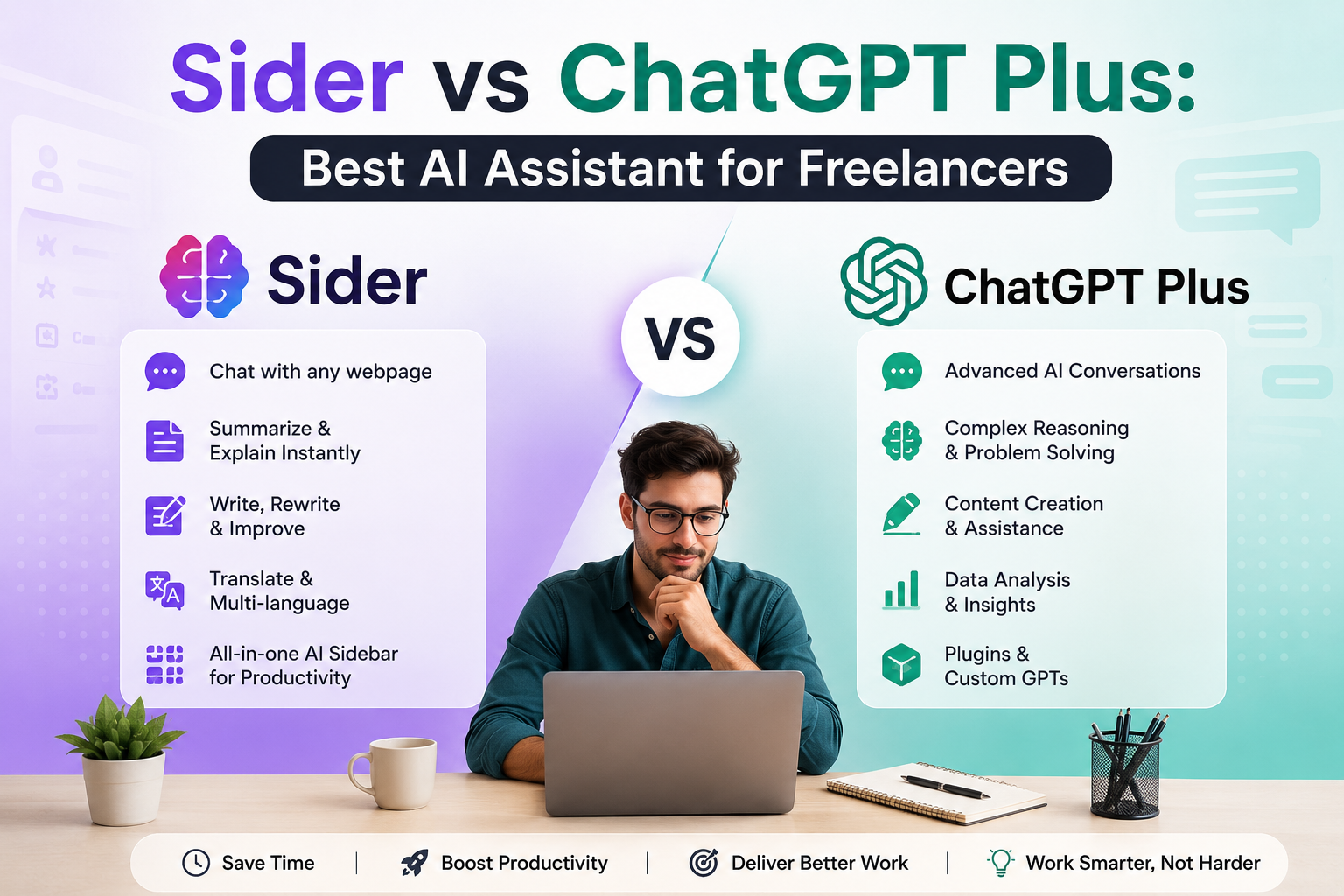
Sider vs. ChatGPT Plus (2026): The Ultimate AI Showdown for Freelancers
In the world of freelancing, time isn’t just a commodity—it’s your most precious, non-renewable asset. Every day is a high-stakes battle against the clock, where you’re forced to pivot constantly between client calls, deep-dive research, content production, and the endless pile of administrative tasks that keep the lights on. It’s a relentless cycle where every minute lost to an inefficient workflow is a minute taken away from your billable hours or your personal life. This pressure creates a massive, undeniable pain point: the urgent need for a force multiplier. Freelancers are searching for a tool that doesn’t just “help,” but fundamentally transforms how they work, allowing a single person to punch at the weight class of a mid-sized agency without the crushing overhead of a full-time staff.
Enter the latest heavyweights in the AI assistant arena: Sider and ChatGPT. These platforms have evolved far beyond the simple “chatbot” label; they are now comprehensive productivity engines built specifically to solve the bottlenecks that stifle solo entrepreneurs. Sider positions itself as the ultimate aggregator—a “Swiss Army knife” that bundles the world’s most elite AI models into a single interface. Meanwhile, ChatGPT (specifically its Plus tier) offers a deep, vertically integrated ecosystem centered on OpenAI’s own cutting-edge research, acting more like a “specialist’s scalpel” for complex reasoning. Both tools promise to redefine freelance productivity, but they approach the problem from two very different philosophies, leaving many freelancers wondering which one deserves a spot in their monthly budget.
This article offers a comprehensive, side-by-side comparison of Sider and ChatGPT Plus, grounded in rigorous research into their pricing structures and feature sets. We’re going to peel back the layers of their core philosophies, break down the actual return on investment for each pricing tier, and see how they perform in real-world freelance scenarios. Whether you’re a writer, coder, or consultant, by the end of this guide, you’ll have a clear, data-backed understanding of which platform is the right investment to help you reclaim your time, supercharge your output, and scale your solo business to new heights.
Deep Dive: The Philosophy of Sider
At its heart, Sider is built for the pragmatist who values choice and versatility above all else. Its underlying philosophy is one of intelligent aggregation. Rather than betting on a single AI model to be the “jack of all trades,” Sider operates on the realistic premise that different models have different strengths. Some models are inherently better at creative storytelling, while others excel at logical deduction, coding, or high-speed data processing. Sider’s mission is to give you a “best-of-all-worlds” experience, providing access to a curated selection of top-tier models—including GPT-5.5, Gemini 3.1 Pro, and Claude Haiku 4.5—all under one roof. It’s the perfect solution for the freelancer who wants to use the right tool for the job without the headache and financial drain of managing five different subscriptions.
You can see this philosophy reflected in Sider’s unique credit system. The breakdown into Basic, Advanced, and Elite credits isn’t just a marketing tactic; it’s a functional roadmap for your workflow. Basic credits power your high-volume, everyday interactions with models like GPT-5.4 mini. Advanced credits are your “heavy lifters,” reserved for the sophisticated logic of GPT-5.5. Most interestingly, the Elite credits are a gateway to high-value, specialized automation like “Deep Research,” “Scholar Research,” and “AI Slides.” This structure tells us that Sider is designed for users who wear many hats—those who might need a quick email summary in the morning, a deep academic research dive in the afternoon, and a full presentation deck generated by the evening.
Sider further cements its status as an all-in-one productivity hub through its “Premium Features.” It goes well beyond text generation to offer workflow-centric tools that address specific digital pain points. With features like the “YouTube Summary” tool, “ChatPDF” for document interrogation, and a built-in “AI Video Shortener,” Sider is clearly targeting the modern content creator and digital marketer. The goal here is consolidation. Sider wants to replace a half-dozen single-purpose apps with one integrated sidebar, effectively streamlining your digital environment and eliminating the “subscription fatigue” that plagues many solo businesses today.
Deep Dive: The Philosophy of ChatGPT
ChatGPT, particularly in its premium and professional tiers, represents the philosophy of the vertically integrated powerhouse. Instead of offering a buffet of external options, OpenAI focuses on providing unparalleled depth within its own proprietary ecosystem. When you subscribe to ChatGPT Plus, you aren’t just getting a chatbot; you’re gaining access to a highly refined reasoning engine that includes GPT-5.5 Instant, GPT-5.5 Thinking, and GPT-5.5 Pro. This is the platform for the freelancer who values a seamless, consistent, and deeply powerful experience—a specialist who would rather master one world-class tool than jump between three or four different ones.
The progression through ChatGPT’s pricing levels—from the Free tier to Go, Plus, and Pro—is essentially a journey into deeper intelligence and expanded memory. One of the most significant differentiators here is the context window. Moving from a 27K context window on the Free plan to 256K on Plus (and a massive 400K on Pro) is a monumental shift for power users. This indicates that ChatGPT is built for “Big Data” freelancers. It’s for the strategist who needs to analyze a 300-page market report in one go, the developer debugging an entire repository, or the consultant synthesizing weeks of interview notes. The focus is on deep, analytical work where the AI needs to maintain a persistent and vast understanding of the project at hand.
Furthermore, ChatGPT is positioning itself as a platform for builders, not just consumers. Features like “Custom GPTs,” “Projects,” and “Tasks,” combined with a robust “Developer mode,” highlight this vision. It’s not just about getting an answer to a question; it’s about engineering your own AI-powered assistants. A freelance financial analyst can build a private GPT trained to interpret specific SEC filings, while a social media manager can create a “Project” that holds all of a client’s brand guidelines and past performance data. This approach appeals to the power user who wants to move beyond “off-the-shelf” AI and build a truly personalized, automated workspace that acts as a custom-tailored extension of their own brain.
Pricing & Value Analysis
When we put the most popular freelancer plans side-by-side—Sider’s Basic/Plus vs. ChatGPT’s Go/Plus—we see two very different approaches to value. Here is how the numbers and features actually stack up based on the latest research.
| Feature | Sider | ChatGPT |
|---|---|---|
| Entry-Level Paid Plan | Basic: $8.3/mo (annual) | Go: $8/month |
| Core “Plus” Plan | Plus: $24.9/mo (annual) | Plus: $20/month |
| Business/Team Plan | Data not provided | Business: $20/user/mo (annual) |
| Key Models (Plus Tier) | Access to Sider Fusion, GPT-5.5, Gemini 3.1 Pro, Grok 4, Claude Haiku 4.5, and more | Access to advanced reasoning with GPT-5.5 Thinking |
| Advanced Capabilities (Plus Tier) | 250 Elite Credits for Deep Research, Scholar Research, Web Creator, AI Slides | Custom GPTs, Projects, Tasks, Expanded Codex, Interactive charts |
| Context Window (Plus Tier) | Not specified in research | 54K (Instant) & 256K (Reasoning) – Approx. 320 pages of text |
| Device Limit (Plus Tier) | 8 Logged-in Devices Max | Not specified in research (typically 2-3) |
| Data Privacy (Personal Plans) | “Commercial Use Allowed” but training policy not specified | Content used to train models (opt-out available) |
In analyzing the ROI for a solo business, the decision boils down to a classic “breadth versus depth” argument. At $24.90/month (billed annually), Sider Plus is a slightly higher investment than ChatGPT Plus at $20/month. However, for that extra five dollars, Sider provides a massive spectrum of utility. The “unlimited” access to a diverse portfolio of the world’s leading models is its primary selling point. As a freelancer, you can experiment to see whether Claude writes better copy or if Gemini handles your data better—all without leaving the app. When you factor in the 250 Elite Credits for tasks like “Web Creator” and the built-in tools like ChatPDF and YouTube Summary, Sider starts to look like a bargain because it effectively replaces multiple $10-$15/month subscriptions, offering incredible consolidated value.
ChatGPT Plus, on the other hand, provides a different but equally compelling ROI based on depth and proprietary power. For a flat $20/month, you get the absolute pinnacle of AI reasoning. The 256K context window is a literal game-changer for anyone managing massive amounts of text or long-term projects. Furthermore, the ability to build and deploy Custom GPTs allows you to create proprietary tools that can actually give you a competitive advantage in your niche. If your work is highly focused and requires building repeatable, automated workflows that “know” your business inside and out, the value of ChatGPT Plus is hard to beat. Ultimately, the “better” value depends entirely on your daily grind: if you need a versatile toolbox for a hundred different tasks, go with Sider. If you need a high-powered, customizable workbench for a few complex, core processes, ChatGPT Plus is your winner.
Feature Head-to-Head
Core AI Models & Reasoning Engine
Sider’s main advantage in the reasoning department is its sheer flexibility. It acts as a master dashboard, giving you a seat at the table with all the industry leaders. This multi-model approach enables a strategy we call “task-matching.” For example, a freelancer could prompt Claude Haiku 4.5 for its nuanced tone when drafting a sensitive client email, immediately switch to GPT-5.5 for a complex architectural logic problem, and then use Gemini 3.0 Flash for a lightning-fast summary of a news article. Sider’s credit system (Basic, Advanced, and Elite) is a direct reflection of this “pay-for-power” philosophy, ensuring you use the most efficient engine for the task and don’t waste “heavy” resources on “light” work.
ChatGPT takes the opposite route, perfecting a single, deeply integrated experience. Instead of a menu of brands, you choose between “modes” of the OpenAI engine. “Instant” is your speedster for quick answers, while “Thinking” or “Pro” handles the heavy cognitive lifting. The crown jewel here is the context window—up to 256K tokens on the Plus plan. This is a massive differentiator. It means ChatGPT can effectively “read” and remember a 320-page book during your session. For freelancers managing long legal contracts, massive coding projects, or months of research notes, this persistent memory is a superpower that Sider’s current specs simply don’t match.
Specialized Tools & Workflow Integration
Sider shines by offering a “plug-and-play” experience with its “Premium Features.” These aren’t just generic chat windows; they are surgical tools for specific freelance headaches. The “YouTube Summary,” “AI Video Shortener,” and “ChatPDF” tools are incredible time-savers for researchers and creators who deal with heavy multimedia. The “AI Translator” for PDFs and images is another huge win for freelancers working with a global client base. Then there are the Elite features—”Web Creator” and “AI Slides”—which actually start doing the work for you by generating entire project assets. This is the ideal setup for someone who wants immediate, one-click solutions without a steep learning curve.
ChatGPT’s approach to workflow is much more “open-ended,” giving you the tools to build your own solutions. The centerpiece is the “Custom GPT” feature. As a freelancer, you can build a fleet of mini-assistants: an “SEO Specialist GPT,” a “Cold Outreach GPT,” or a “Legal Review GPT” trained on your specific preferences. This moves the tool from a reactive assistant to a proactive partner. When you add in “Projects” and “Interactive Tables,” the chat interface begins to feel like a project management system. For the freelancer who wants to systematize their business and create proprietary, repeatable processes, ChatGPT is the far more powerful and flexible canvas.
Data Privacy & Business Use
Sider offers a very clear “green light” for freelancers on its paid plans: “Commercial Use Allowed.” This is vital, as it gives you the legal peace of mind to use AI-generated content in your client deliverables. The ability to log in on up to 8 devices on the Plus plan is also a major practical perk for freelancers who jump between their studio desktop and their laptop at a coffee shop. However, Sider is a bit vague on its data privacy policy for individual plans—specifically whether your inputs are used to train their models. For those handling highly sensitive client data, this lack of transparency might be a small red flag.
ChatGPT handles privacy with a more detailed, tiered approach. On personal plans like Plus, the default is that your data helps train the model, but they provide a clear “opt-out” toggle in the settings. You just have to remember to use it. The real security gold standard, however, is the ChatGPT Business plan. At $20/user/month (billed annually), it offers a rock-solid “No training on your data” guarantee, backed by enterprise-grade security like SOC 2 Type 2 compliance. For any freelancer or agency where data security is a non-negotiable part of their client contracts, the ChatGPT Business plan is the most professionally responsible path available.
Real-World Use Cases for Freelancers
Scenario 1: The Freelance Content Strategist using Sider Plus
Imagine a client—a B2B tech startup—asks a freelancer to take a 45-minute technical webinar and turn it into a massive content package for the month.
- Step 1: Rapid Ingestion. The freelancer uses Sider’s “YouTube Summary” tool to immediately pull a time-stamped transcript and summary of the video. What used to take two hours of watching and note-taking now takes two minutes.
- Step 2: Expanded Intelligence. To make the content stand out, they use 50 Elite Credits on “Deep Research,” asking the AI to find current industry stats and white papers that support the webinar’s main arguments.
- Step 3: Multi-Model Content Creation. Using the research, they ask Sider’s “AI Writer” (using Claude Haiku 4.5 for its superior writing flair) to draft a 1,500-word deep-dive blog post, five LinkedIn posts, and a series of scripts for short-form video.
- Step 4: Visual Design. Finally, they use the “GPT Image 2” feature within Sider to generate a custom header for the blog and social media graphics that match the client’s brand colors. The freelancer completes a week’s worth of work in a single afternoon.
Scenario 2: The Freelance Business Consultant using ChatGPT Plus
A consultant is hired to perform an operational audit for a client. The client hands over a “data dump” PDF—150 pages of internal feedback, financial spreadsheets, and messy process manuals.
- Step 1: Building the Audit Agent. The consultant creates a “Custom GPT” named “Efficiency Auditor” and uploads their own proprietary consulting framework and “best practice” docs as the knowledge base.
- Step 2: Deep Context Analysis. They upload the 150-page client PDF. Thanks to the 256K context window, the GPT can analyze the entire document simultaneously, identifying a contradiction between the financial reports on page 12 and the employee feedback on page 140.
- Step 3: Data Visualization. The consultant asks the GPT to summarize the three biggest bottlenecks and then use the “Interactive tables and charts” feature to create a visual representation of the potential cost savings. This creates a high-end, professional report draft instantly.
- Step 4: Automated Outreach. Finally, they use the Custom GPT to draft tailored emails for each department head, explaining the findings and the next steps, ensuring the tone is professional but firm. The consultant has effectively automated the “grunt work” of the audit.
Pros & Cons Analysis
Sider
- Pros:
- Unbeatable flexibility with one-click access to GPT, Gemini, Claude, and more.
- A massive library of built-in, specialized tools (YouTube Summary, ChatPDF, etc.) that solve specific problems.
- High-power “Elite” features like Deep Research and automated Slide generation for complex projects.
- Clear “Commercial Use Allowed” status on all paid tiers, which is essential for professional work.
- Excellent device support, allowing up to 8 logged-in devices on the Plus plan.
- Cons:
- The three-tier credit system (Basic, Advanced, Elite) can be a bit confusing to track for some users.
- Less clarity on data privacy and model training policies compared to OpenAI’s enterprise offerings.
- Lacks the deep “agent-building” capabilities of Custom GPTs for proprietary workflows.
- The context window is not explicitly defined, which may lead to issues with massive document sets.
ChatGPT Plus
- Pros:
- Access to the industry’s most advanced reasoning engines (GPT-5.5 Thinking/Pro).
- Massive 256K context window is the gold standard for deep, long-form document analysis.
- The “Custom GPT” ecosystem allows you to build a personalized, automated workforce for your business.
- Strong developer features, including advanced Codex usage and sandbox environments.
- Transparent privacy options, including an easy opt-out for individuals and high-level security for Business users.
- Cons:
- You are “walled in” to the OpenAI ecosystem with no access to other leading models like Claude or Gemini.
- Fewer specialized “one-click” tools for media like YouTube or image-to-text translation.
- Data is used for training by default on personal accounts unless you proactively change your settings.
- The $8 “Go” plan is less competitive and may include advertising.
Frequently Asked Questions (FAQ)
- 1. Which tool is better for creating a wide variety of content like blogs, social media posts, and video scripts?
- If your goal is content diversity and high volume, Sider is the clear winner. Its multi-model approach is a content creator’s dream; you can use Claude Haiku for its poetic, human-like blog writing, then switch to GPT for data-heavy social posts. When you add the “YouTube Summary” for ideation and “GPT Image 2” for visuals, Sider becomes a true all-in-one content studio that handles every stage of the creative process in one place.
- 2. I’m a consultant and handle highly confidential client data. Which tool is more secure?
- For data security and peace of mind, ChatGPT (specifically the Business plan) is the superior choice. OpenAI offers very clear, enterprise-grade privacy guarantees, including a “No training on your data” policy for Business and Enterprise users. While Sider allows commercial use, they are less transparent about how your data is used to train their underlying systems. For freelancers dealing with sensitive legal, financial, or proprietary data, the ChatGPT Business plan at $20/month is the most professional insurance policy you can buy.
- 3. The “unlimited” Advanced Credits on Sider Plus sounds too good to be true. What’s the catch?
- There is a small catch to keep in mind. Sider Plus offers “1,500 unrestricted Advanced Credits” per month. The fine print notes that if you exceed this, you might notice a slight reduction in model quality. Essentially, it’s a “fair use” policy. For 99% of freelancers, 1,500 high-level interactions with models like GPT-5.5 is way more than enough for a month of work. Only extreme power users running high-frequency automated scripts would likely hit this ceiling, at which point the system might throttle them to a slightly faster, less “heavy” model.
The Final Verdict
Choosing between Sider and ChatGPT Plus isn’t about finding the “best” AI—it’s about finding the AI that fits your unique freelance personality. Sider is the ultimate generalist, a “Swiss Army knife” that gives you the agility to handle a hundred different tasks with a hundred different tools. ChatGPT Plus is the specialist, a powerful, customizable “workbench” that you can mold into an expert-level extension of your own professional skills. Both are game-changers; they just serve different styles of work.
To make your final decision, look at your typical Tuesday. Are you juggling five different types of media and three different clients? Or are you diving deep into one complex project that requires massive memory and custom automation? Based on our research, here is the final recommendation:
-
- Choose Sider if…
- You want the freedom to choose the best AI model (GPT, Claude, or Gemini) for every specific task.
- Your daily work involves a mix of YouTube videos, PDFs, webpages, and social media.
- You prefer pre-built, “one-click” tools that work instantly without any setup or training.
- You are a “digital nomad” who needs to access your AI assistant across a large number of devices (up to 8).
- Choose Sider if…
- Choose ChatGPT Plus if…
- You regularly analyze huge documents or datasets that require a massive context window (256K+).
- You want to build your own proprietary “Custom GPTs” to automate and systematize your business processes.
- You are a technical freelancer—a developer or researcher—who needs the absolute best in reasoning and coding power.
- Client confidentiality is your top priority and you want the clear, documented security of a Business-tier plan.
2 thoughts on “Sider vs ChatGPT Plus: Best AI Assistant for Freelancers (2026)”